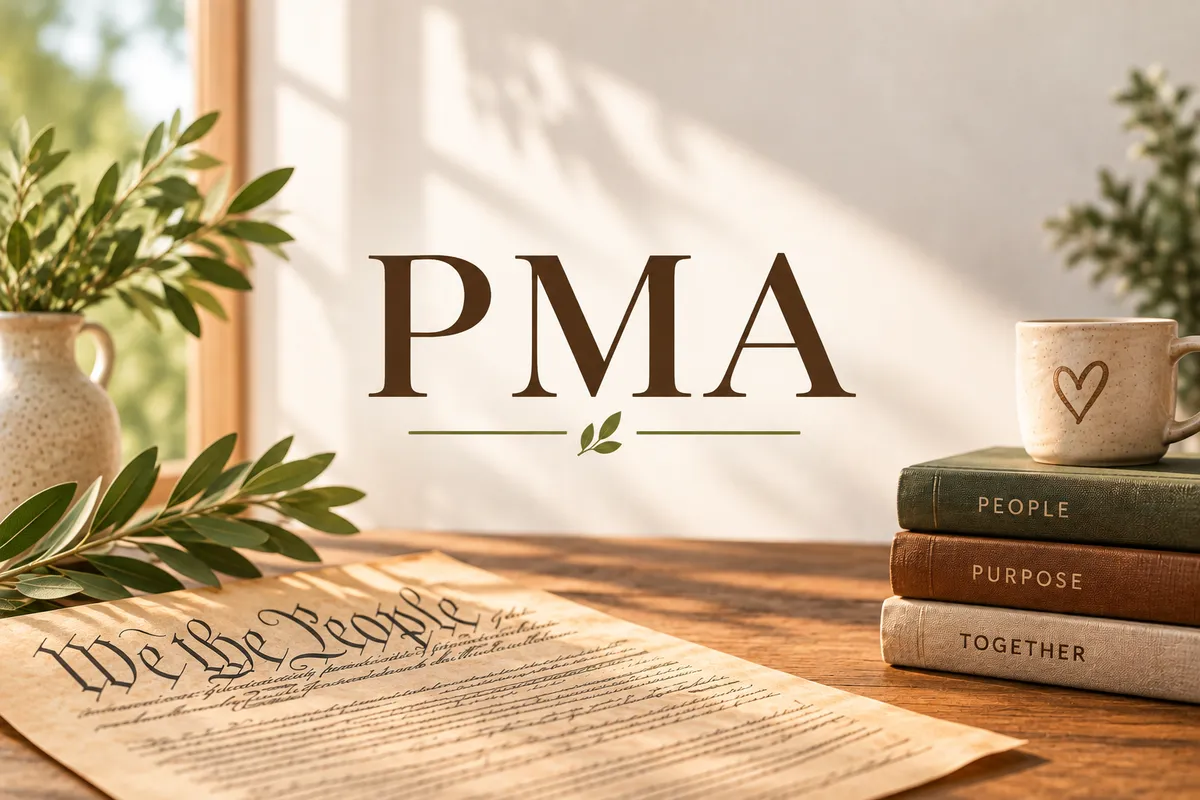
What Is a Private Membership Association?
So, What Exactly Is a Private Membership Association?
If you've spent any time around Abundant Health Ministries, you've probably seen three little letters that aren't particularly familiar to most people: PMA.
It stands for Private Membership Association, and before receiving services through Abundant Health Ministries, individuals become members of our private association.
Sounds very official, doesn't it? Maybe slightly suspicious. Like there should be a secret handshake and a guy at the door checking membership cards. There isn't. 😉
At its simplest, a PMA is a group of people who voluntarily choose to associate with one another around a shared purpose, set of beliefs, interests, or activities and agree to the terms governing that relationship.
And the idea isn't nearly as exotic as the name makes it sound. People have been privately associating forever through churches, clubs, fraternal organizations, professional societies, advocacy groups, ministries, cooperatives, educational organizations—you get the idea. Human beings like getting together with other human beings who care about the same things they do.
What makes an association private isn't simply slapping the word private on a document and declaring yourself free from civilization. There actually has to be an association. There are members. There is a defined purpose. There are terms governing the relationship. And, importantly, people voluntarily decide whether they want to participate. And yes, this is also why the membership agreement is so long. Apparently, “we all understand what we're doing here, right?” isn't quite sufficient legal documentation.
At AHM, that shared purpose centers around health, education, faith, personal responsibility, and the freedom to explore approaches to wellness that may extend beyond the conventional public healthcare model.
Private does not mean lawless. It means the relationship between the association and its members is intentionally private and voluntary.
This Isn't Exactly a New Idea
Americans didn't wake up one Tuesday and invent private associations because somebody wanted to offer alternative healthcare. Long before anyone was arguing about functional medicine, people were forming churches, societies, clubs, political organizations, professional groups, advocacy organizations and other private associations around things they believed mattered.
And naturally, eventually somebody had to argue with the government about where the boundaries were. Because apparently that's also an American tradition.
One of the most important cases came in 1958 with NAACP v. Alabama. Alabama demanded that the NAACP turn over the names and addresses of its members. The organization refused, arguing that disclosure could expose its members to intimidation and retaliation and interfere with their ability to associate freely.
The case went all the way to the U.S. Supreme Court, which sided with the NAACP. The Court recognized what it called the “vital relationship between freedom to associate and privacy in one's associations.”
That's a pretty important sentence.
The issue wasn't simply whether people were technically allowed to join an organization. The Court recognized that government action could burden the freedom itself by making people afraid to associate in the first place.
Over the decades that followed, other cases continued defining—and sometimes limiting—associational rights. In Roberts v. United States Jaycees (1984), the Supreme Court discussed different forms of constitutionally protected association while also making clear that associational freedom is not absolute. Government can sometimes regulate conduct even when associational interests are involved.
Then in Boy Scouts of America v. Dale (2000), the Court again addressed what is known as expressive association—essentially recognizing that forcing an organization to accept certain members can, under some circumstances, interfere with the organization's ability to express its own viewpoints.
Now, none of these cases said, “Congratulations! You may now open a healthcare PMA and ignore every regulation you find inconvenient.”
That's not the point.
The point is that private association isn't some sketchy little legal theory hiding in a dark corner of the internet. There is a substantial body of American constitutional law recognizing that people's ability to join together around shared beliefs and purposes can itself be worthy of protection.
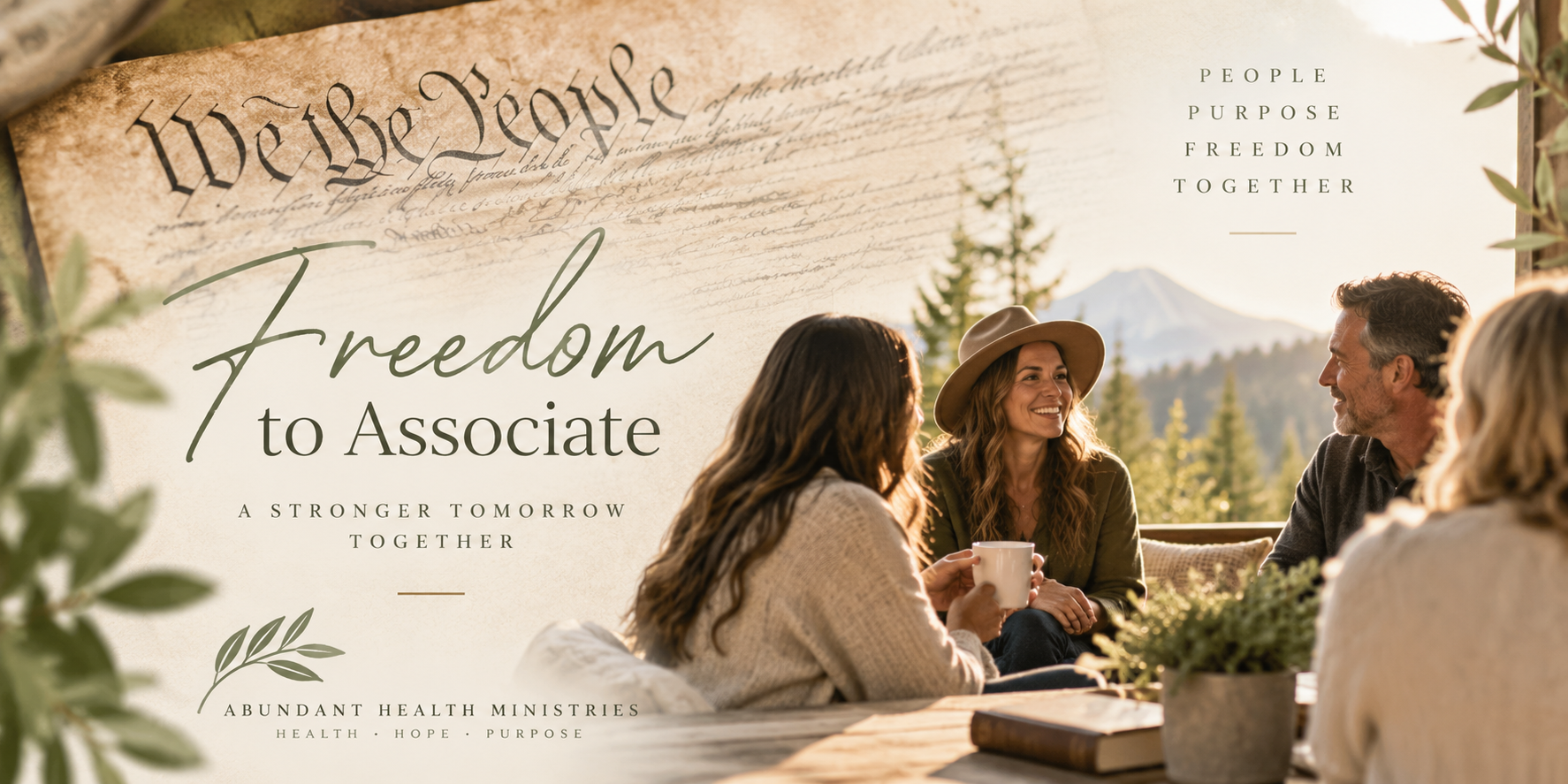
So What Does Any of This Have to Do With Healthcare?
Fair question. Because unless you're planning to start a political advocacy group or invite me into your secret clubhouse, you may still be wondering what any of this has to do with your thyroid, your hormones, your aching knee—or why you have to sign a membership agreement before climbing into my hyperbaric chamber.
For me, the answer comes down to something I've become increasingly passionate about over the years: people should have meaningful freedom when it comes to the way they pursue their health.
I work in what gets called the alternative, functional, or integrative health world. And if you've spent five minutes around me, you already know I'm not particularly interested in asking, “What's the accepted thing to do?” before I ask, “What's actually going on in this person's body?”
That doesn't mean I reject conventional medicine. Not even close. There are times when conventional medicine is absolutely remarkable—and there are times when I will be the first person to tell someone, “Nope. This is not something we mess around with. You need medical evaluation.”
But I also don't believe conventional medicine holds the deed to the human body.
There should be room to ask questions about nutrition, inflammation, metabolic health, environmental exposures, nervous-system regulation, trauma, movement, cellular function, spiritual health—and a whole host of things that don't always fit neatly into a fifteen-minute office visit.
And yes...this is probably where you can hear the faint crinkling of my tin-foil hat.
I believe adults should be able to ask those questions. They should be able to learn, consider different philosophies of health, weigh risks and benefits, and voluntarily choose practitioners and approaches that align with their own values.
But—and this is a big but—freedom also requires responsibility.
That's part of what I appreciate about a private membership model. AHM can clearly say, “This is who we are. This is what we believe. This is how we approach health. These are the terms under which we work together.” And you get to decide whether that makes sense for you.
I don't want to hide what I believe about health in the fine print.
I believe the body was intelligently designed. I believe symptoms often have something underneath them worth investigating. I believe physical, emotional and spiritual health affect one another. I believe education matters. And I believe people should participate in their own health decisions rather than automatically handing every decision over to someone else simply because they have letters after their name.
That doesn't mean expertise doesn't matter. It means your voice matters too.
A private association creates space for people who share enough of that philosophy to voluntarily say, “Yes. This is the kind of relationship I want to participate in.”
And that brings us to the part I really want to address, because I think it's where people can understandably get a little nervous about the word private.
Health freedom isn't about rejecting medicine, expertise, or safety. It's about preserving room for informed adults to ask questions, consider options, and make voluntary decisions about their own health.
So if we're working privately, does that mean there are no standards? No accountability? No safety guardrails?
Are we basically practicing healthcare in the Wild Wild West?
Oh, please. 😂
Private Does Not Mean the Wild Wild West
This is probably the part I care about explaining most clearly, because when people hear private, some immediately translate it as unregulated, unaccountable, everybody-do-whatever-they-want chaos. That is not how I operate. In fact, I would argue the opposite.
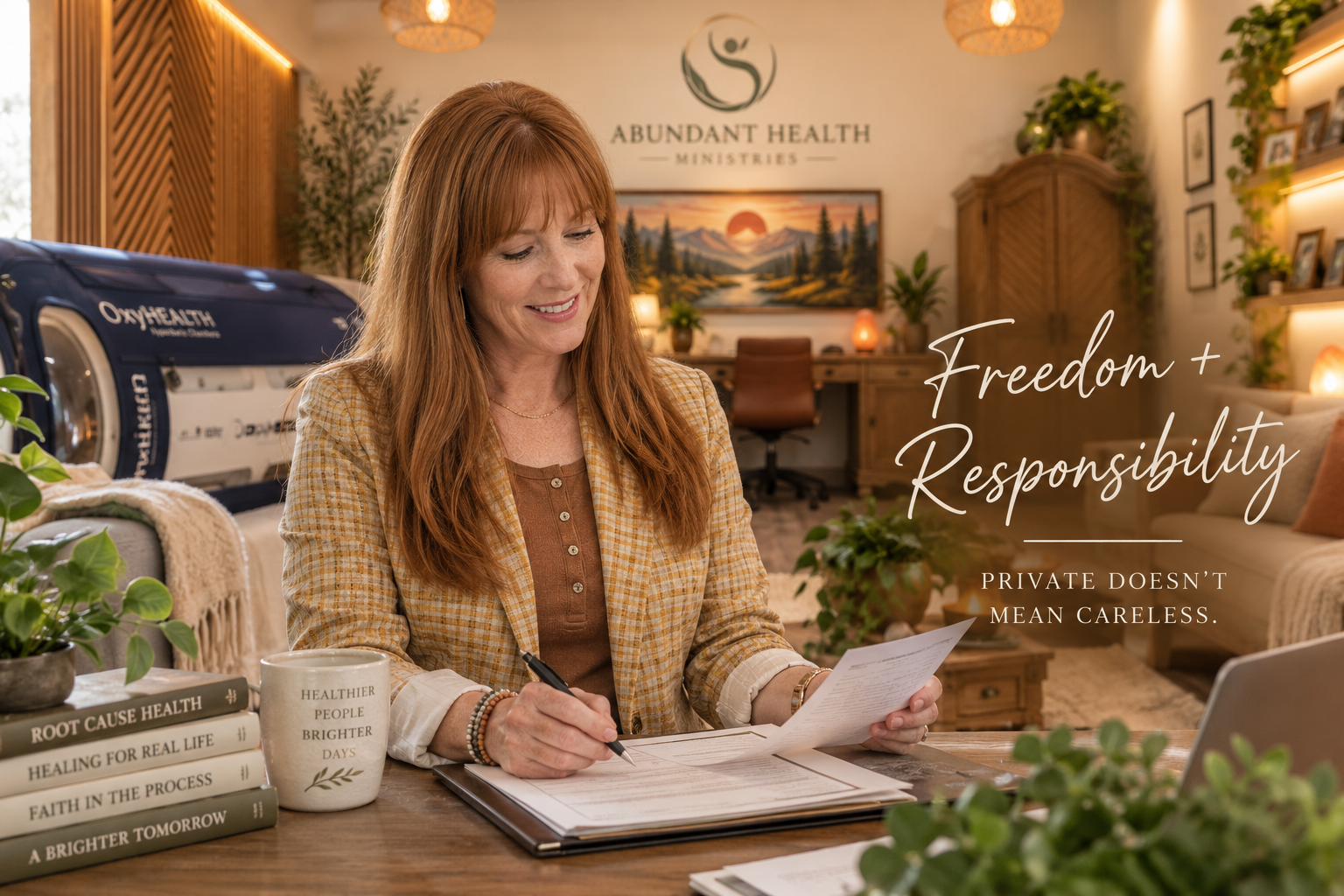
Choosing to work in a private membership model does not make me less concerned about safety, responsibility, appropriate boundaries, or whether something is actually a good fit for the person sitting in front of me. If anything, I feel an even greater responsibility to be thoughtful about those things. I screen. I ask questions. I look for contraindications. I document. I explain risks and benefits. I stay within the areas in which I am trained and competent. And when something is outside my lane—or raises a red flag—I refer out. Sometimes the most responsible thing I can say is, “This is not something we should handle here.” Not terribly rebellious, I know.
There is a tendency to assume that if a practitioner steps outside the conventional public healthcare structure, they must also be stepping away from good judgment. I don't buy that. A license, professional association, hospital system, or regulatory agency can provide structure and accountability, and those systems absolutely have a place. But a structure on paper does not automatically create wisdom, discernment, curiosity, humility, or good clinical judgment. And the absence of that particular structure doesn't automatically mean those things are missing.
The public healthcare system operates inside a dense network of licensing rules, professional standards, institutional policies, liability laws, insurance requirements, and regulatory oversight. Those systems create expectations, responsibilities, protections, and avenues of accountability for both patients and practitioners. A private membership relationship is structured differently—but different does not mean “anything goes.”
It means the relationship, expectations, philosophy, and terms are defined differently. And because of that, I take the responsibility of making those expectations clear very seriously. Hence the rather lengthy membership agreement. See? We brought it full circle. 😂
But here's the bigger point: paperwork isn't the thing that keeps people safe. Careful thinking does. So does knowing when to proceed, when to slow down, when to ask another question, when to recommend further evaluation, and when to say no.
That's the standard I want people to experience at Abundant Health Ministries. Not “We're private, so rules don't matter,” but rather, “We're private, so let's be very clear about what we're doing, why we're doing it, and whether it makes sense for you.”
So What Does Being a Member of AHM Actually Mean?
After all of that constitutional history, healthcare philosophy, and one brief appearance by the Wild Wild West, we can finally get to the question that probably matters most: What does any of this actually mean when you walk through my door?
First, becoming a member doesn't mean you have to agree with me about everything. Good grief, that would make for a very small membership—and some very boring conversations. It means you are voluntarily choosing to receive services within the private structure, purposes, and terms of Abundant Health Ministries, and that you understand the philosophy from which I approach health and wellness.
AHM is unapologetically faith-based. I believe God created the human body with remarkable intelligence and an incredible capacity to heal, repair, adapt, and restore when we identify and address the things interfering with that design. That belief influences the way I think about health, but you don't have to share my faith to be treated with dignity, kindness, and respect here.
You also aren't joining a club where you're expected to abandon your physician, throw away your prescriptions, distrust every hospital, or start forwarding questionable internet videos to your relatives. Please don't tell your cardiologist I said that. 😂
What I do hope membership creates is room for a different kind of conversation—one where we can look beyond a diagnosis and ask what may be contributing to it; where you can ask questions without feeling foolish for asking them; where conventional care and other approaches don't automatically have to be enemies; and where you are expected to participate in your own health rather than simply outsourcing responsibility for it.
That's really the heart of this model for me. A PMA gives AHM a structure in which people can voluntarily come together around a shared philosophy of health, education, faith, personal responsibility, and freedom. The agreement defines that relationship, but the agreement isn't the relationship. The relationship is built on trust, communication, informed choices, and mutual responsibility.
And maybe that's the part of this whole PMA conversation I care about most.
I don't believe health freedom means “Nobody gets to tell me what to do.” I think it means we have both the freedom and the responsibility to learn, ask better questions, seek wise counsel, consider our options, and make thoughtful decisions about the bodies God entrusted to us.
That's the kind of healthcare relationship I want to participate in.
And that's why Abundant Health Ministries is a Private Membership Association.
“For, brethren, ye have been called unto liberty; only use not liberty for an occasion to the flesh, but by love serve one another.”
— Galatians 5:13 KJV
Interested in Becoming a Member?
If the philosophy and approach of Abundant Health Ministries resonate with you, you can learn more about membership, what it includes, and how to get started.
Legal note: This article provides general educational information about private associations and constitutional principles and is not legal advice. Laws and their application vary according to the facts and jurisdiction.
Sources & Further Reading
U.S. Constitution, First Amendment — Constitution Annotated, U.S. Congress
NAACP v. Alabama ex rel. Patterson (1958) — U.S. Supreme Court
Roberts v. United States Jaycees (1984) — U.S. Supreme Court
Educational Disclaimer: Content shared in The Abundant Life is provided for educational and informational purposes only and is not intended to diagnose, treat, cure, or prevent disease or replace individualized medical, mental health, legal, or other professional advice. Information reflects the educational perspectives and opinions of Abundant Health Ministries and should not be interpreted as a substitute for care from an appropriately qualified professional. Always make healthcare decisions based on your individual circumstances.