HBOT: Before & After Pensacola
I Didn’t Go to Pensacola to Be Convinced About HBOT
I've been using hyperbaric oxygen therapy (HBOT) for years, so when I headed to Pensacola, Florida, for the 17th Annual Hyperbaric Therapy & Functional Medicine Conference, I wasn't going because I needed someone to convince me that oxygen is important. I was already on board with that one!
But here's something I've learned over the years: the more you understand about how the body works, the more you realize how much there is still to learn. And when it comes to HBOT, there's a whole lot more happening than simply putting someone in a pressurized chamber and giving them extra oxygen.
I went to Pensacola wanting to dig deeper into the science. I wanted to better understand the physiology, the research, the different treatment protocols, and how HBOT might fit into some of the more complicated health challenges I see in practice.
And boy, did I get an education!
Some presentations reinforced what I've been teaching and practicing for years. Others challenged me to think differently about how we use HBOT, particularly when it comes to the number of treatments, treatment frequency, mitochondrial health, and even its potential role alongside conventional cancer therapies.
There were also some fascinating discussions about conditions like Lyme disease, POTS, PANS/PANDAS, and Ehlers-Danlos syndrome. These are conditions where the body often has multiple systems struggling at the same time, and they're exactly the kinds of complicated health puzzles that make my functional medicine brain light up.
But perhaps my biggest takeaway wasn't about any one condition or even one particular research study. It was a deeper appreciation for the fact that HBOT isn't simply about getting more oxygen into the body. It's about understanding how the body responds to that oxygen, especially when treatments are repeated strategically over time.
And that distinction matters.
Because there is a difference between doing something that temporarily supports the body and creating the conditions that may help the body adapt, repair, and function differently over time.
So I thought I'd share a few of the things I brought home from Pensacola. Not a play-by-play of every lecture (trust me, we'd be here awhile!), but the discoveries, confirmations, and occasional lightbulb moments that I believe are worth talking about.
And we'll start with a question I hear quite often: Why on earth would someone need 40 hyperbaric sessions?
Turns out, there's some pretty fascinating physiology behind that number.
More oxygen is only part of the story. What the body learns to do with it over time is where things get interesting.
Forty Dives? Who Came Up With That Number?
One of the questions I hear most often about hyperbaric oxygen therapy is, "Why do I need so many sessions? Can't I just come in a few times and see how I feel?"
Fair question! Forty sessions is a significant investment of time and money, and I think people deserve to understand the why behind it. This was actually one of my favorite topics at the Pensacola conference because it reinforced something I've believed for a long time: there's a difference between giving the body oxygen and helping the body make lasting changes in response to it.
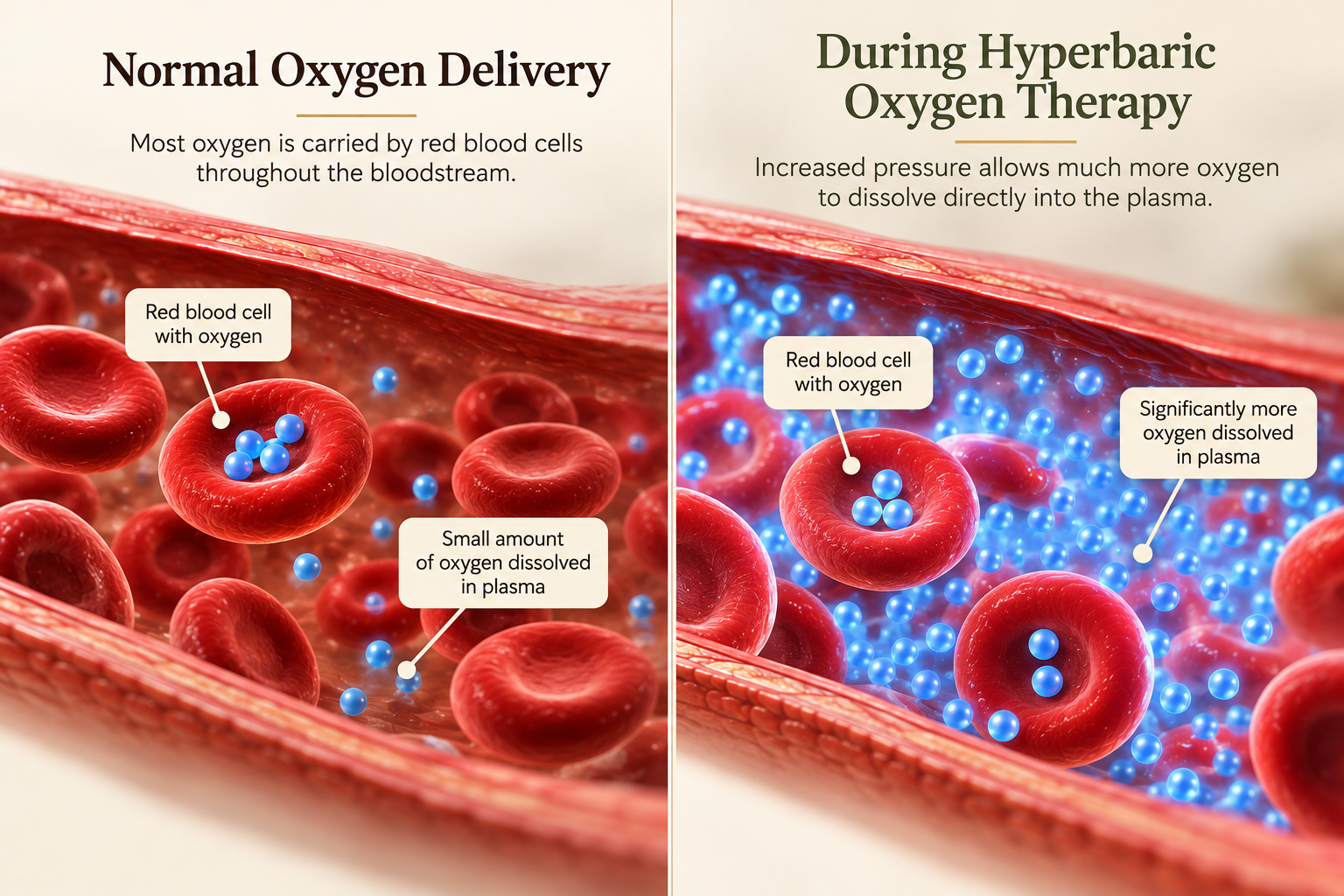
Here's a little physiology to help connect the dots. Normally, most of the oxygen in our blood is carried by red blood cells. But under increased atmospheric pressure, HBOT allows significantly more oxygen to dissolve directly into the plasma (the liquid portion of our blood). That means additional oxygen can reach tissues through the circulation, even in some areas where oxygen delivery has been compromised.
But what really caught my attention in Pensacola wasn't just how oxygen gets delivered. It was the discussion about what happens when we repeat that exposure over time.
Several presenters discussed something called the hyperoxic-hypoxic paradox. Essentially, repeated periods of increased oxygen followed by a return to normal oxygen levels can activate cellular signaling pathways that are also associated with low oxygen. Strange, right? But those signals may help stimulate processes involved in forming new blood vessels, cellular repair, and tissue adaptation.
And that's where the conversation about 40 sessions starts to make sense.
A single HBOT session can temporarily increase oxygen availability, but some of the biological changes we're hoping to encourage take repeated exposures over several weeks. It's a little like exercise. One workout has benefits, but the bigger adaptations come from consistency.
Now, 40 isn't some magical number that works for everyone. Different conditions require different protocols, and some applications of HBOT are still being researched. But understanding the physiology behind repeated treatments gave me an even greater appreciation for why a structured course of care matters.
I came home from Pensacola with a deeper understanding of something I want every person considering HBOT to know: we're not simply counting sessions. We're considering what repeated, carefully dosed oxygen exposure may help the body accomplish over time.
And Then There Are My Beloved Mitochondria!
If you've spent any time talking with me about health, you already know I have a bit of an obsession with mitochondria. Those tiny powerhouses inside our cells are responsible for producing much of the energy our bodies need to function, repair, and thrive. And when they're not functioning well, the ripple effects can be felt throughout the body.
So imagine my delight when mitochondrial health kept coming up during the Pensacola conference! Apparently, I'm not the only one who thinks these little guys deserve more attention.
Here's why this matters so much to me: recovery requires energy. Whether we're talking about repairing damaged tissue, rebuilding after an injury, regulating inflammation, or simply recovering from the demands of chronic illness, our cells need energy to do that work. And much of that energy comes from our mitochondria.
When mitochondrial function is compromised, the body may struggle to keep up with those demands. It's not necessarily that the body doesn't know how to repair itself; sometimes the cells simply don't have the energy resources to support all the work that needs to happen.
One of the fascinating discussions in Pensacola centered on how repeated HBOT sessions may support mitochondrial function and even mitochondrial biogenesis (the creation of new mitochondria). In other words, we're not just looking at delivering more oxygen for immediate energy production. Researchers are exploring whether carefully dosed oxygen exposure can help cells improve their energy-producing capacity over time.
Of course, more oxygen doesn't automatically mean healthier mitochondria. The dose, timing, and individual response still matter, and there's plenty more to learn. But I came home with an even greater appreciation for why mitochondrial health belongs in nearly every conversation about recovery.
I certainly didn't need to fly all the way to Florida to become a mitochondrial enthusiast. That ship sailed a long time ago! But the conference reinforced something I wish more people understood: healing isn't just about giving the body what it needs. It's also about helping the body have the energy to use it.
Repair takes resources. Recovery takes energy. And mitochondria help make both possible.
The Chamber Is the Capsule, Not the Medicine
One of my favorite moments at the Pensacola conference came during Dr. Shai Efrati's presentation. He made a comparison that really stuck with me: the hyperbaric chamber is like a capsule. The treatment is what's inside it.
Think about that for a moment. When you take a medication, the capsule is simply the delivery system. What matters is what's inside, how much you're taking, and how your body responds. The same principle applies to hyperbaric oxygen therapy.
The chamber provides the controlled environment, but the actual treatment involves the pressure, oxygen concentration, duration, frequency, and even the changes in oxygen exposure during a session. Those variables influence the physiological response we're trying to encourage.
And this is where HBOT gets particularly interesting to me. Two people can spend the same amount of time inside a chamber and receive very different treatments depending on how those variables are managed. Someone recovering from an injury may have different needs than someone dealing with a complex chronic condition.
What I brought home from Pensacola was a renewed appreciation for the importance of individualized protocols rather than a one-size-fits-all approach. It's not simply about getting someone into a chamber and turning up the pressure. It's about understanding why we're using a particular protocol, what we're hoping to accomplish, and whether the available research supports that approach.
Because ultimately, having access to a hyperbaric chamber is one thing. Knowing how to use it thoughtfully and appropriately is another.
The Oncology Conversations That Changed My Thinking
Of everything I learned in Pensacola, the oncology presentations probably had the greatest impact on me. Not because I had never considered HBOT in the context of cancer care. I have worked with people navigating cancer diagnoses before. But I came home with a much deeper appreciation for the importance of timing, dosing, and working alongside conventional oncology care.
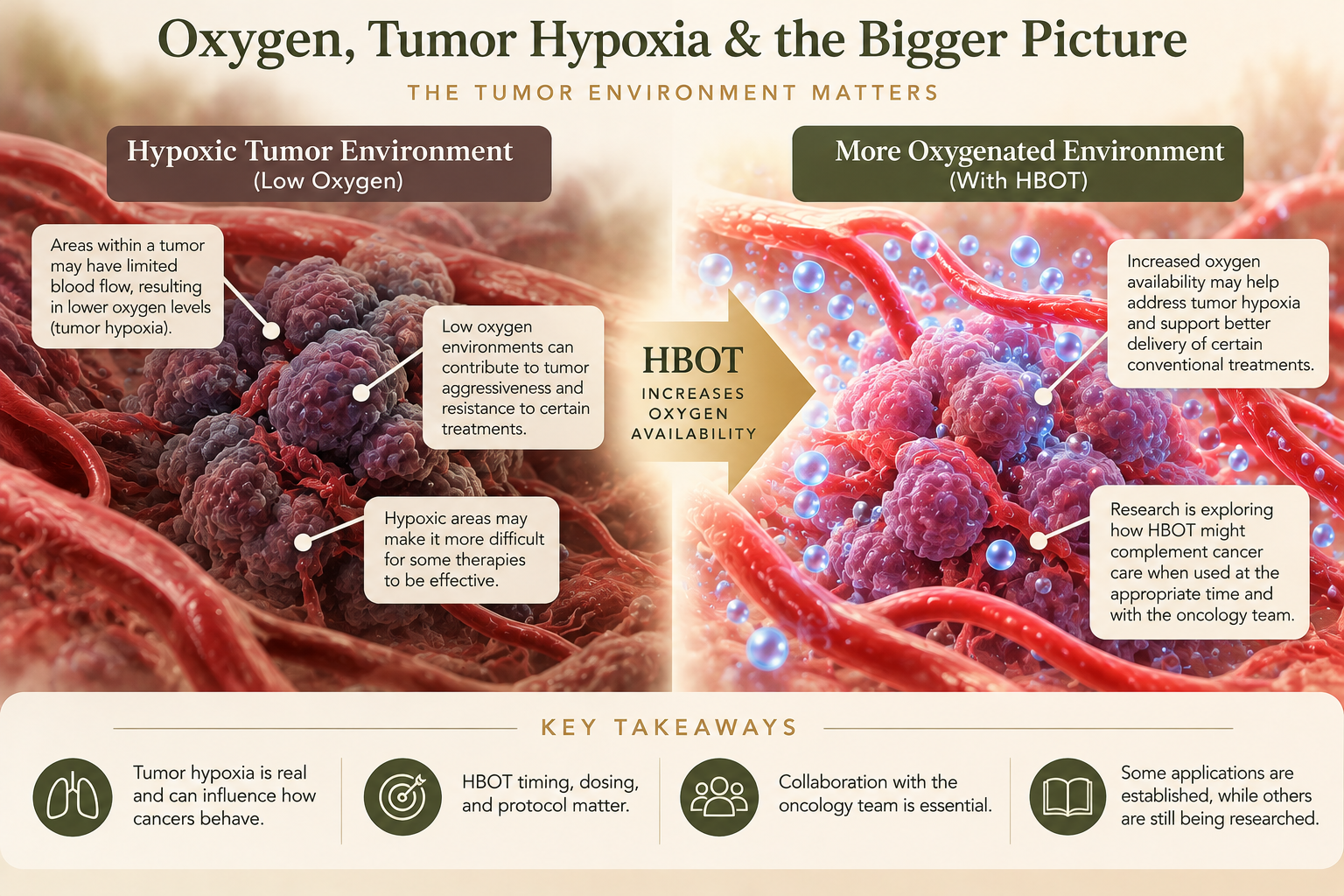
One of the fascinating discussions centered on something called tumor hypoxia, which simply means areas within a tumor aren't receiving adequate oxygen. Interestingly, those low-oxygen environments can contribute to tumor aggressiveness and resistance to certain cancer treatments. So the relationship between oxygen and cancer is far more complicated than the old argument that giving someone oxygen will somehow "feed" their cancer.
What particularly caught my attention was the research exploring whether carefully timed HBOT might help address tumor hypoxia and potentially complement certain conventional treatments. But here's an important distinction: using HBOT to treat certain complications of cancer treatment, such as delayed radiation injury, is already an established medical application. Using HBOT to improve cancer treatment outcomes is still being investigated. Those are not the same thing, and I think we need to be careful about how we communicate that.
The biggest shift for me was recognizing just how important collaboration with the oncology team can be. Rather than thinking of HBOT as something separate from conventional medicine, I came home thinking more deeply about how these approaches might work together when the evidence, timing, and individual circumstances support it.
And I appreciate that perspective. I'm not interested in an either/or approach to health care when there may be value in bringing different disciplines to the same table. That doesn't mean every therapy belongs in every treatment plan, but it does mean we should be willing to ask thoughtful questions and follow the evidence.
I left Pensacola with more questions to explore, more research to dig into, and a greater respect for how carefully HBOT needs to be considered in oncology. Not because I believe it is a cancer treatment on its own, but because understanding where it may appropriately fit into the bigger picture matters.
The goal isn't to choose between approaches. It's to understand when working together may serve the person better.
The Conditions That Had Me Taking Extra Notes
Beyond the discussions about treatment protocols and oncology, there were several presentations in Pensacola that really caught my attention. Particularly those exploring HBOT in some of the more complicated conditions we encounter in functional medicine.
Lyme disease, POTS (postural orthostatic tachycardia syndrome), PANS/PANDAS, and Ehlers-Danlos syndrome (EDS) were among the topics discussed. At first glance, these conditions may seem unrelated, but many involve overlapping challenges with inflammation, nervous system regulation, circulation, and cellular energy production.
And that's what made these conversations so interesting to me.
When someone is dealing with a complex chronic condition, we're often looking at multiple systems struggling at the same time. Supporting just one piece of that puzzle may not be enough. The discussions in Pensacola encouraged me to think more deeply about whether HBOT might have a supportive role in addressing some of those underlying physiological challenges.
I was particularly interested in the conversations around dysautonomia (when the autonomic nervous system isn't regulating things like heart rate and blood pressure properly), neuroinflammation, and the relationship between connective tissue disorders and nervous system function. These are areas where researchers are still working to understand the bigger picture.
Now, I want to be clear that HBOT is not an established treatment for these conditions, and much of the research is still preliminary. But that doesn't make the questions being asked any less fascinating. It simply means we need to approach emerging applications with curiosity, discernment, and a healthy respect for what we don't yet know.
I came home with a longer reading list and several new questions worth exploring. And for someone who loves connecting the dots between seemingly unrelated health challenges, that's a pretty good souvenir from Florida!
Complex conditions rarely involve just one system. So why would we expect recovery to involve only one?
Not All Hyperbaric Chambers Are Created Equal
One of the things that really stood out to me in Pensacola was the emphasis on hyperbaric chamber safety. And quite frankly, I'm glad this conversation is happening because the growing popularity of HBOT has also brought a growing number of chambers onto the market. And no, they're not all created equal!
There was considerable emphasis on using FDA-cleared chambers, proper equipment standards, and understanding the differences between devices. Now, anyone who knows me knows I'm not necessarily the biggest cheerleader for government agencies (especially those with three-letter names, haha!), but when we're talking about pressurized environments, oxygen delivery, and human safety, I absolutely appreciate the importance of appropriate oversight.
And here's where I get a little opinionated. A less expensive chamber isn't necessarily a bargain if safety and quality have been compromised. There's a reason medical-grade equipment, proper engineering, maintenance, and safety protocols come with a price tag. And while cost alone doesn't determine whether a chamber is safe, cutting corners in this area is not something I'm willing to entertain.
The conference reinforced my commitment to understanding the equipment I use, the protocols I follow, and the responsibility that comes with providing HBOT. Because the chamber isn't simply a wellness gadget. It's equipment operating under pressure, and that deserves respect.
For me, the takeaway was simple: effective treatment matters, but safety is never optional.
Heading Home: New Insights, Bigger Perspective, Same Mission
If there's one thing Pensacola reinforced for me, it's that HBOT doesn't work in isolation, and neither does the human body. Oxygen is an important piece of the healing process, but so are mitochondrial function, nervous system regulation, nutrition, inflammation, and the body's ability to actually use the resources we're giving it.
That's why I've always appreciated combining different approaches rather than expecting one therapy to do all the heavy lifting. Whether it's HBOT, BrainTap, red light therapy, functional medicine, or simply helping someone make meaningful changes in their daily habits, the goal isn't to pile on more therapies. It's to understand what that particular person needs and why.
So, what changes at Abundant Health Ministries now that I'm home? Honestly, not everything! I'm not returning with some shiny new miracle treatment or a completely different philosophy. But I am returning with a deeper understanding of HBOT protocols, a greater appreciation for collaboration, and plenty of research I want to explore further.
And perhaps that's the best part of continuing to learn after all these years. The more I understand, the more intentional I can be with the people who trust me to walk alongside them in their health journeys.
I didn't come home believing in HBOT more. I came home understanding how much more there is to using it well.
And THAT was worth the trip to Pensacola!

Medical note: This article shares personal insights and educational information from the 2026 Hyperbaric Therapy & Functional Medicine Conference. Some applications discussed are emerging or investigational and are not established treatments for the conditions mentioned. HBOT is not a substitute for appropriate medical care, including conventional cancer treatment. Individual suitability, treatment protocols, and safety considerations should be evaluated with qualified healthcare professionals.
Sources & Further Reading
The Hyperoxic-Hypoxic Paradox — Hadanny & Efrati, 2020.
Hyperbaric Oxygen Therapy and Cancer: A Review — Moen & Stuhr, 2012.
Breaking the Hypoxia Barrier: Advances and Challenges of HBOT in Cancer Treatment — Meng et al., 2025.
Hyperbaric Oxygen Therapy: Recognized Indications — Undersea & Hyperbaric Medical Society.
FDA: Safe Use of Hyperbaric Oxygen Therapy Devices — FDA, 2025.
Educational Disclaimer: Content shared in The Abundant Life is provided for educational and informational purposes only and is not intended to diagnose, treat, cure, or prevent disease or replace individualized medical, mental health, legal, or other professional advice. Information reflects the educational perspectives and opinions of Abundant Health Ministries and should not be interpreted as a substitute for care from an appropriately qualified professional. Always make healthcare decisions based on your individual circumstances.